
DISC or the Enneagram? Five questions for a Seychellois management team

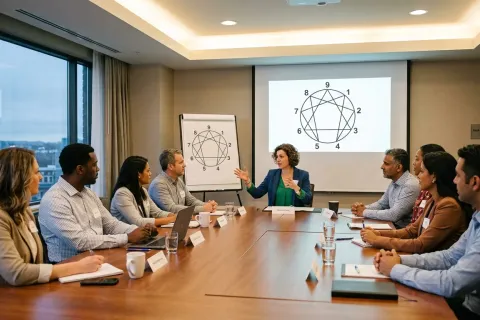
Many Seychellois companies are small enough that the management team fits around one table: an owner, a finance person, an operations manager, perhaps a head of sales or a head chef. When that team decides to work on how it communicates, the question comes quickly. DISC or the Enneagram?
Both models are serious, both are widely used, and they do not answer the same question. A short definition of each sits in the glossary. What follows is not a debate about the models. It is five questions about your team, which usually settle the matter in a few minutes.
1. What is the problem you want to solve?
If it is friction, meaning meetings that drag, two managers who cannot run a project together, handovers between shifts that go wrong, start with DISC. Friction is usually a mismatch of style: one person wants the conclusion first, the other wants the detail, a third needs to feel the relationship is fine before discussing anything. DISC names those differences in a way people can use the next morning.
If it is a pattern that repeats, meaning the same conflict with different people, a colleague whose reactions seem out of proportion, a leader who keeps taking on everything, the Enneagram is more useful. It works on the layer where those patterns come from: what someone is trying to obtain or to avoid.
2. How many first languages are in the room?
In a Seychellois team, the answer is often three or more. Kreol, English and French for Seychellois staff, plus Hindi, Tamil, Malagasy or Swahili among colleagues from abroad.
DISC copes well with this. Four dimensions, simple words, examples taken from everyday work. A group that shares no first language can use the vocabulary together by the end of the first day.
The Enneagram needs more nuance. Talking about what drives you and what you fear is hard in a language you only use for procedures. It works best when the session runs in a language everyone is comfortable with, which in practice means English or French, and when the group is given time.
3. How much trust is there between the people in the room?
DISC can be done with a team that does not yet trust itself. It talks about behaviour, which everyone can already see.
The Enneagram asks people to say things about themselves that are not visible. A team without trust will give careful, polite answers. The session will feel deep and change nothing.
4. Who will meet whom after the session?
This question matters more in Seychelles than in a large city. The finance manager and the operations manager may sit on the same parish committee. Their children may be in the same class. What is said in a session about motivations and fears must stay in the room, completely.
DISC exposes little that is sensitive. The Enneagram exposes more, and it only works if everyone is certain that nothing will circulate. Say this explicitly at the start, and make sure the facilitator does not report individual results to anyone.
5. How much time can you give it?
DISC produces something usable in one or two days. The Enneagram takes longer to settle, and its value comes from returning to it over several months. If the high season leaves the team one free day in the next six months, DISC is the realistic choice.
If you are still unsure
Start with DISC. It is quicker, it resolves most friction on its own, and it tells you whether the remaining problem is deeper than style. A team that finishes a DISC session saying “we understand each other better but we still cannot work together” has just identified its need for the Enneagram.
Whichever model you choose, one rule applies: a profile is a hypothesis, not a verdict. “She is a D, that is why” ends the conversation. “She is probably a D, so what does she need from me on this project?” starts it.
Where to go from here
DISC and Driving Forces covers DISC in depth over two days. Managing with the Enneagram applies the Enneagram to the day-to-day work of a manager. Self-awareness and positive communication uses both models for teams that want to work on communication as a whole.
Frequently asked questions
Can the questionnaires be taken in French or Kreol?
DISC and Enneagram questionnaires exist in English and French, and our sessions are run in English or French. We do not offer a Kreol version. In a mixed team, participants usually take the questionnaire in the language they read most comfortably, and the discussion happens in the language the group chooses.
Is one model better suited to a hotel team than to an office?
Not by nature. DISC is often more practical for operational teams because its four dimensions translate directly into situations such as a handover, a guest complaint or a busy service. The Enneagram tends to be more useful for a small management team that works closely together over years.
Will the owner or the general manager see individual results?
No. Individual results belong to the participant. When a company commissions a session, we can share anonymised group patterns if this is agreed in advance, and participants are told what will be shared before they answer anything.
Training on this topic

Interpersonal communication
DISC and Driving Forces
Two instruments that answer different questions: DISC describes how a person behaves, Driving Forces describes why. Two days, an individual report for each participant, and a worked relationship strategy for the colleagues they find hardest.

Interpersonal communication
Self-awareness and positive communication
The foundation programme behind most of the others. Two days using DISC and the Enneagram to see your own communication defaults, recognise the situations where they cost you, and build enough flexibility to reach people who work nothing like you.
Management
Managing with the Enneagram
The Enneagram describes nine ways of being motivated, and nine things that reliably go wrong under pressure. One day to recognise your own profile, read your team, and stop managing everyone as though they wanted what you want.